
Walnut Creek City Directory Holdings
The confirmed local set is narrower than a generic search result may suggest. The Library of Congress has a free scan of the Contra Costa telephone directory for March 1949 through September 1950, and the Walnut Creek Library holds newspaper microfilm and genealogy tools. Contra Costa County Historical Society records add tax books, maps, court material, obituaries, and related books. No authoritative catalog located a complete Walnut Creek Polk, Haines, reverse, criss-cross, or Sanborn run, so those labels belong in a research question, not in a claim that a collection exists.
| Collection | Years | Publisher or record maker | Where held | Access |
|---|---|---|---|---|
| Contra Costa telephone directory | Mar. 1949-Sep. 1950 | Pacific Telephone | Library of Congress | Free page images and OCR |
| Walnut Creek newspaper microfilm | 1930-1972, with gaps by title | Local newspaper publishers | Walnut Creek Library | In-library microfilm reader |
| Assessor books, maps, courts and directories | 1850-1910 for assessor books; other runs vary | Contra Costa County records and local collections | CCCHS History Center | Free review; research service available |
| Polk, reverse, criss-cross and Sanborn runs | Not confirmed | No verified local catalog run | Do not assign a shelf without confirmation | Ask the holding repository first |
The table separates a scanned directory from companion sources. A newspaper can place a person at an address in a given month, while a tax book can show property context. Neither turns every name into a resident. Start with the source that matches the question and preserve the exact year and wording.
The Contra Costa County Historical Society collections page is the best visual overview of the county material behind the historical trail.
That collection view helps distinguish a repository catalog from a digitized city directory. The underlying pages may still require a visit or a research request.
Walnut Creek Directory Run, 1949-1950
The Library of Congress scan is the one Walnut Creek telephone directory run that the research confirms. Walnut Creek pages begin around image 60 in the March 1949 to September 1950 volume. Entries put the surname first, followed by a given name or initial, an address written as a street, road, lane, highway, or locality, and a telephone number. An r marks a residence. That is a subscriber clue, not proof that every member of a household lived there.
OCR is useful for a first pass, but the scan controls. Check letter shapes, initials, road names, and the number against the page image. Nearby same-surname entries may help, yet they do not prove kinship. Household composition, spouse, owner status, and a broad description of daily life generally do not appear in these pages. The volume is Pacific Telephone, not a Polk occupation directory.
Local quirk. The 1949-1950 pages preserve rural roads, lanes, and localities just before Walnut Creek grew through postwar subdivision. Keep that rural wording beside a map or later address rather than silently converting it to a modern street format.
For a direct comparison, open the Library of Congress telephone-directory scan and read the image alongside the OCR text. It is a stronger citation than an unsourced claim that a broader city directory series survives.
Reading a Walnut Creek Directory Entry
A historical entry should be copied as a record, not rewritten as a biography. The scan gives a subscriber line. Its value comes from the exact name, the address form, the residence mark, and the phone number, then from comparison with another source from the same period. In a Walnut Creek city directory search, the spelling and punctuation can matter as much as the apparent match.
| Name | Surname first, then given name or initials. |
|---|---|
| Residence mark | r identifies a residence listing in the confirmed telephone run. |
| Address | Street, road, lane, highway, or locality as printed. |
| Telephone | The listed subscriber number for that snapshot. |
| Not supplied | Household composition, a full ownership marker, and a complete resident list. |
- Subscriber
- The person or household named on the telephone account, which may not equal every occupant.
- Criss-cross directory
- A directory arranged by address, often with a name section as well. No authoritative Walnut Creek run was confirmed.
- Householder index
- A name-led finding aid for a head of household or listed person. It is not automatically a full household census.
- Abbreviation key
- The volume’s explanation of short forms and marks. Find it before interpreting an unfamiliar entry.
Those definitions prevent a common comparison error. A telephone listing can locate a subscriber in time and space. A census page can show an enumerated household. A deed can show parties to a transfer. Each answers a different question.
Walnut Creek Library Directory Resources
Walnut Creek Library at 1644 N. Broadway, Walnut Creek, provides the city-level starting point for historical research. The branch phone is 925-977-3340. Its microfilm reader supports the local newspaper runs, while the special genealogy collection includes American and regional genealogy, family histories, military personnel, immigration and passenger sources, church registers, and ethnic genealogy. Licensed Ancestry Library Edition and HeritageQuest add census images and local-history pages from inside the library.
A librarian can help separate a newspaper title from a directory title, identify a microfilm format, or suggest a census search when the directory wording is rural. LINK+ provides access across more than 55 California libraries and 4.5 million unique titles, which can matter when a local shelf has a gap. The branch is a better first call than assuming that a commercial search result represents a verified Walnut Creek city directory.
The Walnut Creek Library genealogy and branch page anchors the location, phone, and collection details.
The library image belongs with the access question: microfilm and licensed databases are useful channels, but a scan or database hit still needs its source year and page noted.
Walnut Creek Historical Directory Holdings
The Contra Costa County Historical Society at 724 Escobar Street in Martinez is the county’s strongest companion repository. Its History Center holds yearly assessor books, supervisor, treasurer, and school records, more than 9,300 indexed historic cases naming more than 61,000 people, probate by decedent, naturalization records from 1850 through 2008, early vital and cemetery indexes, obituaries, biographies, books, directories, and more than 1,700 maps dated from 1775 into the 1990s. Research begins with a free review. Personal-use research is listed at $20 per hour for members and $30 for nonmembers, with on-site nonmember research at $20 per hour.
Call 925-229-1042 or write to info@cocohistory.org before relying on a delicate map or an unverified directory title. Maps require appointments. The History Center can bridge a directory gap with tax context, a court index, a naturalization file, or an obituary, but a catalog reference is not the same as a page-level search result.
The CCCHS photo search is a separate way to test a name, place, or civic setting in the historical catalog. It may show an affiliation or local scene, not current residence.
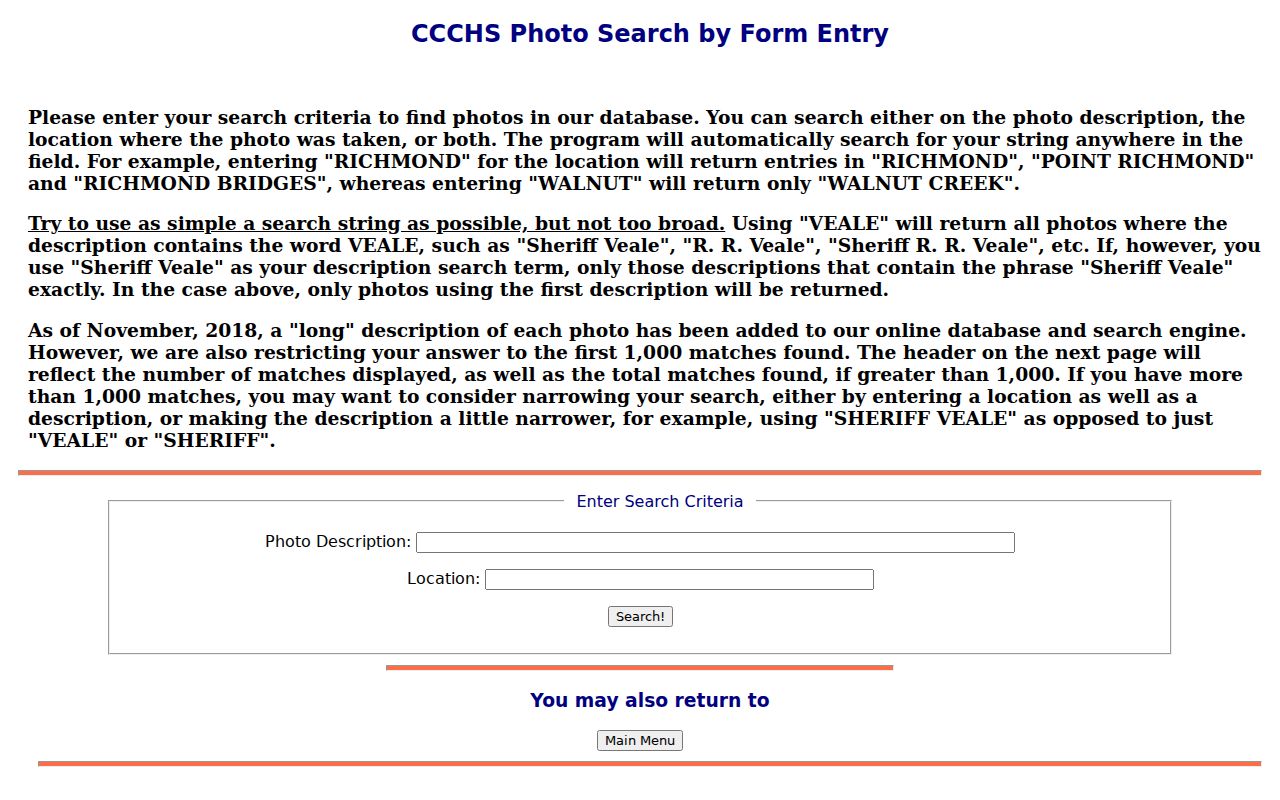
The photo catalog is most useful as a lead to a date, group, or place that can be checked against the directory and newspaper record.
For a planned visit or research request, the CCCHS research page explains the available channel and service context.
That second view is a reminder to ask for the exact collection, year, and access condition instead of requesting an unsupported all-years directory search.
Walnut Creek Newspaper Directory Gaps
Walnut Creek newspapers can confirm an address at a finer point in time than a one-year directory. They may carry an obituary, a civic notice, a sale report, or a street reference. They also have gaps, so the absence of a notice is not evidence that a person was absent. Record the title, date, page, and wording, then compare it with the telephone listing or census.
| Title | Confirmed run | Access | Useful comparison |
|---|---|---|---|
| Courier Journal | Oct. 9, 1930-Oct. 31, 1946 | Walnut Creek microfilm | Earlier address and obituary clues |
| Walnut Creek Courier-Journal | Nov.-Dec. 1946; Apr. 1948-Dec. 1951 | Walnut Creek microfilm | Bridges the 1949-1950 phone volume |
| Walnut Kernel | Jun.-Dec. 1950; 1957-Nov. 1, 1972 | Walnut Creek microfilm | Local notices and later address context |
| Walnut Creek Sun | Jan. 1955-May 14, 1965 | Walnut Creek microfilm | Postwar neighborhood changes |
| Walnut Creek Journal | 1990+ paper; 1996+ NewsBank | Library and database | Later notices and searchable text |
The exact title runs are listed on the Walnut Creek Library historical newspaper holdings page. Use its format notes before planning a visit. A newspaper reference can support a household trail without being mistaken for a city directory.
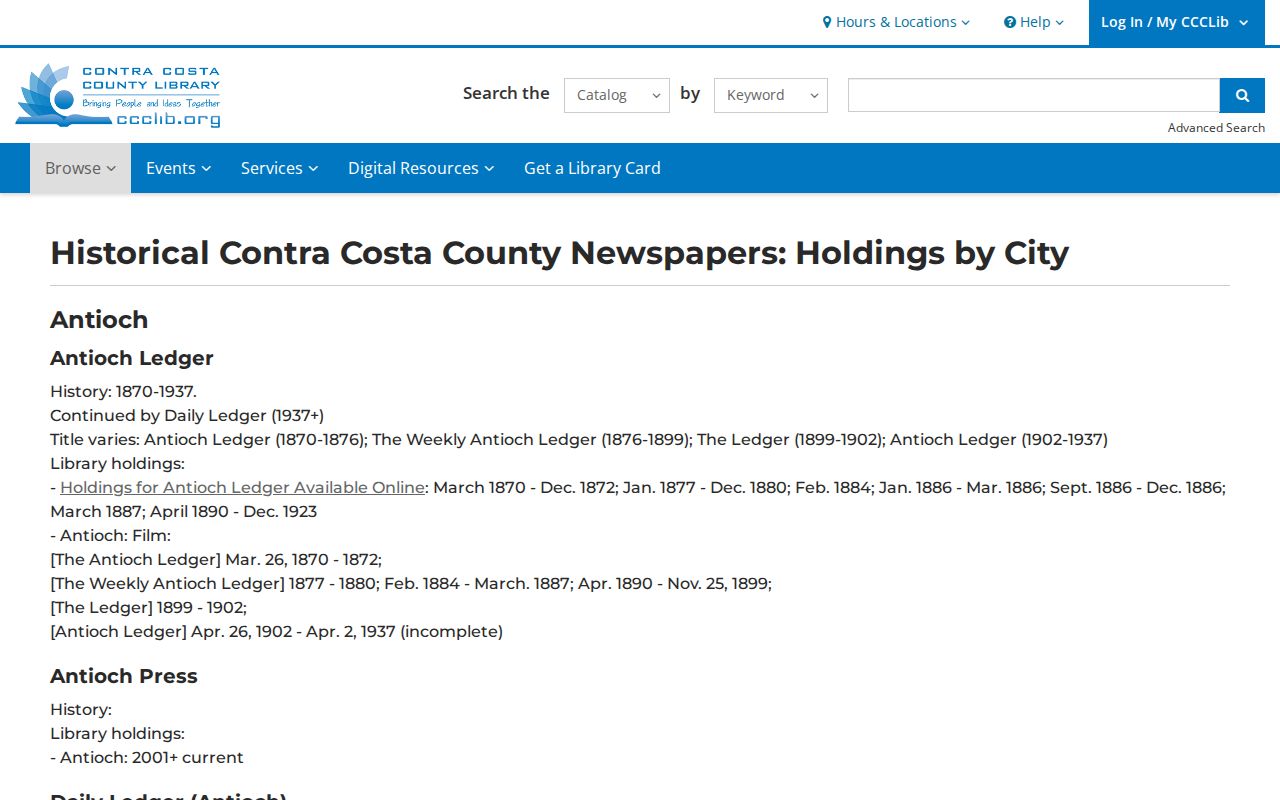
The newspaper holdings image pairs with the coverage table: each title has its own gaps, so the date range belongs in every research note.
Walnut Creek Directory and Census Pairing
The telephone volume supplies a listed subscriber. Census pages supply an enumerated household through 1950, subject to the census record and its address detail. A useful Walnut Creek city directory workflow puts both sources on the same timeline instead of treating a single match as final. The 1950 Contra Costa search is available through NARA, and the Walnut Creek Library provides Ancestry Library Edition and HeritageQuest for in-library research.
- Copy the directory entry exactly, including initials, residence mark, road wording, and number.
- Search the same surname and nearby address in the 1950 census, checking the enumeration district and street order.
- Compare household names, ages, and place clues without forcing a match when the address is rural or incomplete.
- Use a newspaper notice or CCCHS obituary, probate, or map record to explain a move or a name that disappears.
- Save the page image, census reference, and source year as separate citations.
An enumeration district is the area assigned to a census taker. It helps narrow a page, but it does not repair a changed street name. Census schedules are also snapshots. Pairing them with a directory, newspaper, and map produces a stronger family-history sequence than a name-only search.
The official 1950 Contra Costa census search is the appropriate starting point for that comparison.
Walnut Creek Directory’s 1850 Substitute
NARA reports that no 1850 population schedules survive for Contra Costa, San Francisco, or Santa Clara counties. That is a major gap for anyone trying to place early Walnut Creek households. The surviving 1850 assessor book at CCCHS is therefore unusually valuable. It is property and tax context, not a federal household census, but it can preserve an owner, parcel description, or local name when the population schedule cannot.
Contra Costa was one of California’s original 27 counties, created on February 18, 1850, and Martinez has remained the county seat. Louis Stein rescued county assessment volumes when the county moved from paper to microfilm; his 1984 donation helped seed the History Center. Walnut Creek’s older place story also matters: the settlement began as “The Corners,” Homer Shuey’s 1871-1872 subdivisions shaped the street pattern, Southern Pacific arrived in 1891, and incorporation followed in 1914.
- 1849
- William Slusher arrived by Arroyo de las Nueces.
- 1850
- Contra Costa County was created; surviving assessor material helps offset the lost population schedule.
- 1871-1872
- Homer Shuey subdivisions remain visible in the street pattern.
- 1891 and 1914
- Southern Pacific arrived; Walnut Creek incorporated later.
- 1950-1973
- Population rose through the postwar decades; BART arrived in 1973.
Those dates are context for a record trail, not a substitute for a page image. They explain why an early assessor book, later telephone listing, and modern map may use different names for the same place.
Known Walnut Creek Directory Limits
Honest comparison is part of a useful Walnut Creek city directory search. The confirmed telephone volume is a free scan with subscriber entries. The newspaper runs are local microfilm with title-specific gaps. CCCHS has rich historical material, but the research did not locate an exhaustive year list for Polk, Haines, reverse, or criss-cross directories. No authoritative Walnut Creek Sanborn year set was located either. A missing catalog result should stay labeled as unknown.
Do not overread a gap. “Not confirmed” means the local run was not verified in the research, not that no copy exists anywhere. Ask the Walnut Creek Library or CCCHS for a title, year, publisher, and access condition before describing it as part of the collection.
The April 2026 library inventory refresh is useful for checking exact newspaper formats and years. For municipal records that are not part of a directory shelf, the Walnut Creek City Clerk accepts online and mail California Public Records Act requests, gives an availability determination within ten calendar days, and lists a $0.10 per page charge. That channel can locate a defined city record, but it does not create a resident list or fill an unverified directory run.
A final citation should name the repository, collection, year, page or image, and the role shown. “Subscriber,” “enumerated household,” “assessor record,” and “newspaper notice” are safer than treating every historical name as a confirmed resident.